
Introduction
Microquasars are double stellar systems in our Galaxy. They were named this way because some relativistic phenomena that was first observed in the faraway quasars can be seen in microquasars as well. They produce well collimated, relativistic particle outflows - jets. The central double system probably contains a black hole.
Microquasars as a class of objects were discovered in the early nineties. They are prominent in the X-rays but some of them are powerful in the radio regime, especially during outbursts. It is believed that by studying microquasars we can better understand the processes going on in active galactic nuclei, like formation of the jets and particle acceleration to relativistic energies.
SS433
The first stellar system with well collimated jets was discovered at the end of the seventies. SS433 is a unique source because its midly relativistic jets contain not only light particles like electrons and positrons, but also heavy atomic nuclei which produce peculiar spectral lines from optical to the X-rays. This is the brightest permanent radio source amongst microquasars, an easy target for VLBI observations.
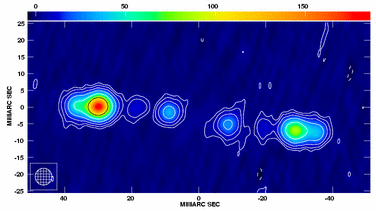
Below is a 5-GHz radio image, observed with the VLBA. SS433 was found in a rare outburst stage on 16 April 1998. The inner radio jets disappeared while pairs of bright radio components were ejected from the centre.
Contact
Questions about microquasar research at JIVE should be directed to Zsolt Paragi.